100 Quotes by John F. Kennedy and the Context Behind Them
John F. Kennedy’s most widely recognized and impactful quotes, along with short notes that add context and meaning behind each one.
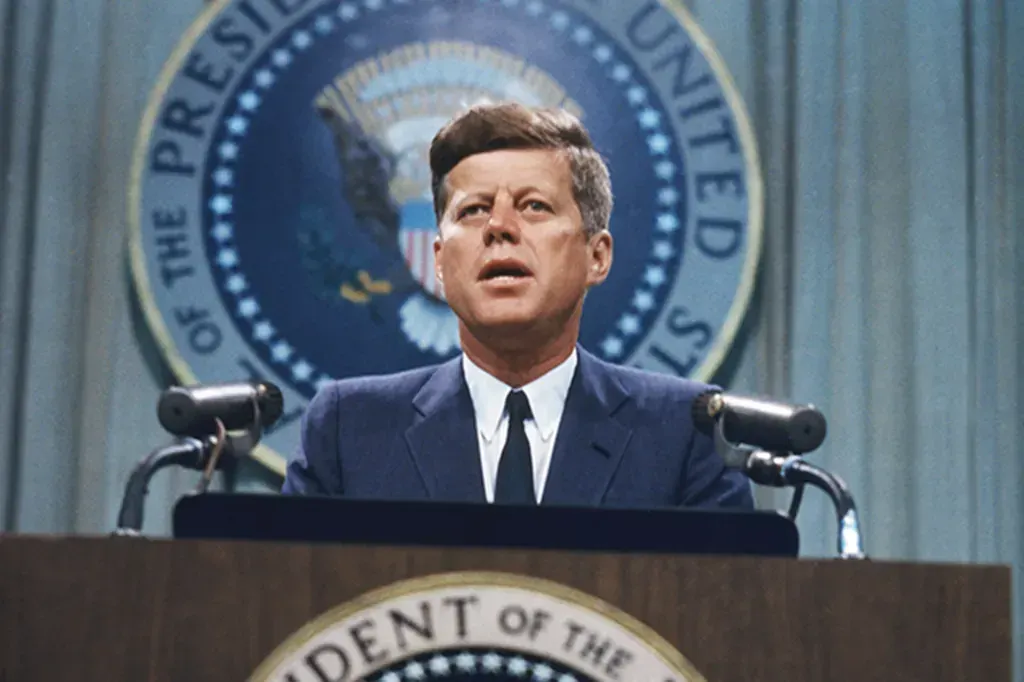
John F. Kennedy remains one of the most influential voices in modern political history. As the 35th President of the United States, his words shaped a generation defined by Cold War tensions, rapid social change, and the dawn of the space age. But beyond politics, JFK’s speeches carry a timeless quality—blending urgency, optimism, and a strong belief in public service.
From his iconic inaugural address to his reflections on leadership, courage, and peace, Kennedy’s quotes continue to circulate in classrooms, leadership books, and everyday conversations around the world. Some of his lines became global rallying cries, while others offer quieter lessons about responsibility, change, and human potential.
This collection brings together 100 of John F. Kennedy’s most widely recognized and impactful quotes, along with short notes that add context and meaning behind each one.
1. "Ask not what your country can do for you—ask what you can do for your country."
JFK delivered this line during his inaugural address on January 20, 1961. It became one of the most famous political quotes in American history.
2. "Let us never negotiate out of fear. But let us never fear to negotiate."
This quote came from the same inaugural address and reflected JFK's Cold War approach to diplomacy.
3. "Change is the law of life. And those who look only to the past or present are certain to miss the future."
JFK used this quote while discussing the need for political and social progress during the 1960s.
4. "The time to repair the roof is when the sun is shining."
Kennedy used this metaphor to encourage preparation before crises occur.
5. "Those who dare to fail miserably can achieve greatly."
This quote is frequently cited by entrepreneurs, athletes, and motivational speakers.
6. "If not us, who? If not now, when?"
JFK used variations of this challenge to inspire public service and civic action.
7. "A man may die, nations may rise and fall, but an idea lives on."
Kennedy often emphasized the lasting power of ideas over individuals.
8. "Forgive your enemies, but never forget their names."
This is one of JFK's most quoted lines, though historians continue to debate the exact occasion when he first said it.
9. "Efforts and courage are not enough without purpose and direction."
JFK believed leadership required both determination and a clear vision.
10. "Conformity is the jailer of freedom and the enemy of growth."
This quote reflects Kennedy's support for innovation and independent thinking.
11. "Leadership and learning are indispensable to each other."
The quote is frequently used in leadership development programs around the world.
12. "The rights of every man are diminished when the rights of one man are threatened."
JFK spoke these words during the civil rights movement as racial equality became a major national issue.
13. "Mankind must put an end to war before war puts an end to mankind."
Kennedy made this statement during one of the most dangerous periods of the nuclear age.
14. "Victory has a thousand fathers, but defeat is an orphan."
JFK used this remark after the failed Bay of Pigs invasion in 1961.
15. "We choose to go to the Moon."
Kennedy delivered this challenge at Rice University in 1962, helping launch America's race to the Moon.
16. "Things do not happen. Things are made to happen."
The quote captures Kennedy's belief in personal responsibility and action.
17. "The goal of education is the advancement of knowledge and the dissemination of truth."
JFK frequently highlighted education as essential to democracy.
18. "Tolerance implies no lack of commitment to one's own beliefs. Rather it condemns the oppression or persecution of others."
This quote is often cited in discussions about religious freedom and pluralism.
19. "We must find time to stop and thank the people who make a difference in our lives."
This remains one of JFK's most popular gratitude-themed quotations.
20. "As we express our gratitude, we must never forget that the highest appreciation is not to utter words, but to live by them."
Kennedy believed actions were more meaningful than expressions of thanks alone.
21. "The great enemy of the truth is very often not the lie—deliberate, contrived, and dishonest—but the myth."
JFK said this at Yale University in 1962 while discussing how public misconceptions can influence policy.
22. "A child miseducated is a child lost."
Kennedy used this line to emphasize the importance of educational investment and reform.
23. "There are risks and costs to a program of action. But they are far less than the long-range risks and costs of comfortable inaction."
This quote is frequently used in business and leadership circles to encourage decisive action.
24. "Our progress as a nation can be no swifter than our progress in education."
JFK viewed education as the foundation of economic growth and national competitiveness.
25. "One person can make a difference, and everyone should try."
This remains one of Kennedy's most quoted statements about civic responsibility.
26. "Physical fitness is not only one of the most important keys to a healthy body; it is the basis of dynamic and creative intellectual activity."
Kennedy strongly promoted physical fitness and even encouraged Americans to take long walks to improve their health.
27. "When written in Chinese, the word 'crisis' is composed of two characters. One represents danger and the other represents opportunity."
JFK popularized this famous interpretation during speeches, although language experts later noted that the translation is oversimplified.
28. "Let every nation know, whether it wishes us well or ill, that we shall pay any price, bear any burden..."
This powerful pledge came from JFK's inaugural address in 1961 during the height of the Cold War.
29. "The ignorance of one voter in a democracy impairs the security of all."
Kennedy often stressed the importance of an informed electorate.
30. "The world knows that America will never start a war. This generation of Americans has had enough of war and hate."
JFK spoke frequently about balancing military strength with the pursuit of peace.
31. "We are not here to curse the darkness, but to light the candle that can guide us through that darkness."
Kennedy used this metaphor to encourage optimism and constructive leadership.
32. "Too often we enjoy the comfort of opinion without the discomfort of thought."
This quote remains popular in discussions about critical thinking and public discourse.
33. "Liberty without learning is always in peril; learning without liberty is always in vain."
JFK borrowed and promoted this idea while emphasizing the relationship between education and freedom.
34. "We prefer world law in the age of self-determination to world war in the age of mass extermination."
Kennedy made similar arguments while advocating for international cooperation during the nuclear era.
35. "The problems of the world cannot possibly be solved by skeptics or cynics whose horizons are limited by the obvious realities."
JFK believed ambitious goals required imagination and optimism.
36. "Let us think of education as the means of developing our greatest abilities."
Kennedy frequently connected education to national strength and individual opportunity.
37. "Geography has made us neighbors. History has made us friends. Economics has made us partners. Necessity has made us allies."
JFK said this while speaking about relations between the United States and Canada.
38. "We stand today on the edge of a New Frontier."
This phrase became the name of Kennedy's domestic policy agenda during the 1960 presidential campaign.
39. "I think this is the most extraordinary collection of talent, of human knowledge, that has ever been gathered together at the White House..."
Kennedy humorously added, "...with the possible exception of when Thomas Jefferson dined alone," creating one of his most memorable jokes.
40. "The rising tide lifts all the boats."
Kennedy popularized this phrase while discussing economic growth, and it remains a common expression in economics and politics today.
41. "Let us seek not the Republican answer or the Democratic answer, but the right answer."
Kennedy often urged Americans to put national interests above party politics, especially during major challenges.
42. "We cannot negotiate with people who say what's mine is mine and what's yours is negotiable."
JFK used this line to describe the difficulties of dealing with aggressive adversaries during the Cold War.
43. "The one unchangeable certainty is that nothing is unchangeable or certain."
This quote reflects Kennedy's belief that leaders must adapt to changing circumstances.
44. "The courage of life is often a less dramatic spectacle than the courage of a final moment."
Kennedy wrote this in his Pulitzer Prize-winning book Profiles in Courage, highlighting everyday acts of bravery.
45. "Without debate, without criticism, no administration and no country can succeed—and no republic can survive."
JFK made this statement before newspaper publishers in 1961 while defending the importance of a free press.
46. "For time and the world do not stand still. Change is the law of life."
Kennedy frequently returned to the theme of change as a driving force in history and politics.
47. "We are tied to the ocean. And when we go back to the sea, whether it is to sail or to watch, we are going back from whence we came."
This quote is especially popular among sailors and marine conservation groups.
48. "A nation reveals itself not only by the men it produces but also by the men it honors."
JFK believed public monuments and commemorations reveal a society's values.
49. "The basic problems facing the world today are not susceptible to a military solution."
Kennedy increasingly emphasized diplomacy after the near-catastrophe of the Cuban Missile Crisis.
50. "If a free society cannot help the many who are poor, it cannot save the few who are rich."
Kennedy used this line in his inaugural address to argue that prosperity should benefit all citizens.
51. "Let every nation know that we shall support any friend, oppose any foe, to assure the survival and the success of liberty."
This was one of the strongest commitments made during JFK's inaugural speech.
52. "We must use time as a tool, not as a couch."
Kennedy encouraged Americans to view time as something to invest rather than waste.
53. "The supreme reality of our time is the vulnerability of this planet."
JFK spoke about humanity's shared risks during the nuclear age, emphasizing global cooperation.
54. "There is only one path to peace—the path of dialogue and negotiation."
This message became increasingly important in Kennedy's speeches after major Cold War confrontations.
55. "The energy, the faith, the devotion which we bring to this endeavor will light our country and all who serve it."
These words concluded JFK's inaugural address and helped define the optimism of the early 1960s.
56. "Communism has never come to power in a country that was not disrupted by war or corruption, or both."
Kennedy made similar arguments while discussing global ideological competition during the Cold War.
57. "Modern cynics and skeptics see no harm in paying those to whom they entrust the minds of their children a smaller wage than is paid to those to whom they entrust the care of their plumbing."
JFK used this quote to advocate for greater respect and compensation for teachers.
58. "The Chinese use two brush strokes to write the word 'crisis.' One brush stroke stands for danger; the other for opportunity."
This became one of JFK's most repeated observations, despite later debate about its linguistic accuracy.
59. "We have the power to make this the best generation of mankind in the history of the world—or to make it the last."
Kennedy frequently warned that nuclear weapons made humanity's choices more consequential than ever before.
60. "Our most basic common link is that we all inhabit this small planet. We all breathe the same air. We all cherish our children's future. And we are all mortal."
JFK delivered this powerful message in his 1963 American University Commencement Address, one of the most important peace speeches of his presidency.
61. "A rising tide lifts all boats."
Kennedy often used this phrase to argue that broad economic growth benefits the entire society, not just a few individuals.
62. "The greater our knowledge increases, the greater our ignorance unfolds."
JFK frequently reflected on the limits of human knowledge despite rapid scientific progress.
63. "I am an idealist without illusions."
This quote captures Kennedy's effort to balance optimism with political realism.
64. "The unity of freedom has never relied on uniformity of opinion."
Kennedy believed democratic societies are strengthened by disagreement and open debate.
65. "History is a relentless master. It has no present, only the past rushing into the future."
JFK often spoke about the responsibility of leaders to shape history rather than simply react to it.
66. "The ancient Greek definition of happiness was the full use of your powers along lines of excellence."
Kennedy used this idea to encourage Americans to pursue excellence in public and private life.
67. "No government or social system is so evil that its people must be considered as lacking in virtue."
Kennedy said this while advocating peaceful coexistence and understanding between nations.
68. "The human mind is our fundamental resource."
JFK frequently highlighted education, research, and innovation as America's greatest assets.
69. "A man does what he must—in spite of personal consequences, in spite of obstacles and dangers and pressures."
This line comes from JFK's reflections on political courage in Profiles in Courage.
70. "The very word 'secrecy' is repugnant in a free and open society."
Kennedy made this statement in a 1961 speech to newspaper publishers while discussing transparency and national security.
71. "We are the heirs of that first revolution."
JFK often connected contemporary challenges to the ideals of the American Revolution.
72. "Every accomplishment starts with the decision to try."
This quote is widely attributed to Kennedy, although historians debate whether it can be traced to a verified source.
73. "The rights of man come not from the generosity of the state, but from the hand of God."
Kennedy used this argument to emphasize that fundamental rights exist independently of government.
74. "There is little value in insuring individuals against one kind of disaster if they are left exposed to another."
JFK said this while discussing social welfare and public policy reforms.
75. "Too often we enjoy the comfort of opinion without the discomfort of thought."
This remains one of Kennedy's most cited observations about critical thinking and public discourse.
76. "I look forward to an America which will reward achievement in the arts as we reward achievement in business or statecraft."
Kennedy was a strong supporter of the arts and believed culture played a vital role in national identity.
77. "When power leads man toward arrogance, poetry reminds him of his limitations."
JFK spoke these words at a White House event honoring poet Robert Frost in 1963.
78. "When power narrows the areas of man's concern, poetry reminds him of the richness and diversity of existence."
This quote comes from the same tribute to Robert Frost and is often cited by writers and educators.
79. "The problems of the world cannot possibly be solved by skeptics or cynics."
Kennedy believed progress depended on people willing to imagine possibilities beyond current limitations.
80. "Our task is not to fix the blame for the past, but to fix the course for the future."
JFK frequently urged Americans to focus on solutions rather than dwelling on past mistakes.
81. "We choose to go to the Moon in this decade and do the other things, not because they are easy, but because they are hard."
Delivered at Rice University in 1962, this speech helped define the U.S. space race and led directly to the Apollo program.
82. "Space is there, and we're going to climb it."
A simplified version of JFK’s space vision, often quoted to capture his ambition for NASA.
83. "The exploration of space will go ahead, whether we join in it or not."
Kennedy used this reasoning to justify massive investment in space exploration during the Cold War.
84. "We set sail on this new sea because there is new knowledge to be gained."
Another line from his Rice University “Moon speech,” describing space as a new frontier.
85. "No one has a right to receive the blessings of liberty unless he is willing to share it."
JFK often tied freedom to civic responsibility and public service.
86. "The only way to do great work is to love what you do."
While widely attributed to Kennedy, this quote is often misattributed and may have been paraphrased in motivational literature.
87. "A nation that is afraid to let its people judge the truth and falsehood in an open market is a nation that is afraid of its people."
This reflects JFK’s strong support for free press and transparency.
88. "In a democracy, every citizen is a sovereign, and every sovereign has responsibilities."
Kennedy frequently reminded Americans that democracy requires active participation.
89. "Let us not be blind to our differences—but let us also direct attention to our common interests."
This was part of JFK’s broader message of unity during Cold War tensions.
90. "We must face the fact that the United States is neither omnipotent nor omniscient."
JFK acknowledged American limits in foreign policy, especially after early Cold War crises.
91. "Peace is a daily, a weekly, a monthly process."
Kennedy emphasized that peace requires constant effort, not just treaties.
92. "War will exist until that distant day when the conscientious objector enjoys the same reputation and prestige that the warrior does today."
JFK often explored moral and philosophical dimensions of war and peace.
93. "The world is very different now. For man holds in his mortal hands the power to abolish all forms of human poverty and all forms of human life."
This comes from JFK’s 1961 inaugural address during heightened nuclear tensions.
94. "We must never forget that art is not a form of propaganda; it is a form of truth."
Kennedy strongly supported arts funding and cultural programs during his presidency.
95. "Tolerance does not mean a lack of commitment to one's beliefs."
JFK consistently promoted tolerance during the civil rights era.
96. "Ask not only what you can do for your country, but what you can do for your world."
A globalized interpretation of his famous inaugural message, often used in modern adaptations.
97. "Leadership and learning are indispensable to each other."
Frequently cited in leadership training programs worldwide, especially in education and management.
98. "The United States is a friend to freedom everywhere, but a custodian only of our own liberty."
JFK balanced international support for democracy with respect for national sovereignty.
99. "The ignorance of one voter in a democracy impairs the security of all."
Kennedy emphasized civic education as essential to national stability.
100. "Let us never negotiate out of fear. But let us never fear to negotiate."
Repeated here as a closing reminder of JFK’s philosophy of diplomacy during the Cold War.

